Ad Testing Solved Context. Outcomes Are the Harder Problem.
Creative testing has advanced more in the past few years than it did in the previous fifteen.
The best ad tests now run inside replica feeds and ad breaks, alongside competing content, on the platforms where the ads will actually run. Attention is observed rather than claimed. Emotion is tracked second by second. Benchmarks are built on hundreds of thousands of executions.
This is real progress, and it solved a real problem. An ad tested on a blank screen, with nothing competing for attention, was answering a question no media plan would ever ask.
But solving context exposes what context was hiding.
The most important number is still the one people are asked for
Put an ad in a realistic environment and you can now establish, with confidence, whether it was noticed, whether it held attention, whether it was understood, and whether it was liked.
Then comes the question every budget ultimately depends on:
Did it change what people buy?
In most pre-tests, this is where observation ends and self-report begins. How likely are you to buy? Would you consider this brand?
After all the behavioral rigor upstream, the outcome that matters most is still measured by asking people to predict their own behavior, one of the things people are worst at predicting.
AI does not close this gap on its own. Many of the new instant-prediction tools are trained on large databases of exactly these survey answers. A model trained on what people say learns to predict what people say. A faster prediction of a prediction is still a prediction.
Ad testing and shopper research grew up apart
There is a structural reason for this, and it is not negligence.
Ad testing grew out of TV copy testing and recall scores. Shopper research grew up at the shelf.
They developed different methodologies, different vendors, and often different stakeholders within the same company. The link between them has always been an assumption:
The ad tested well. The product is on shelf. It should sell.
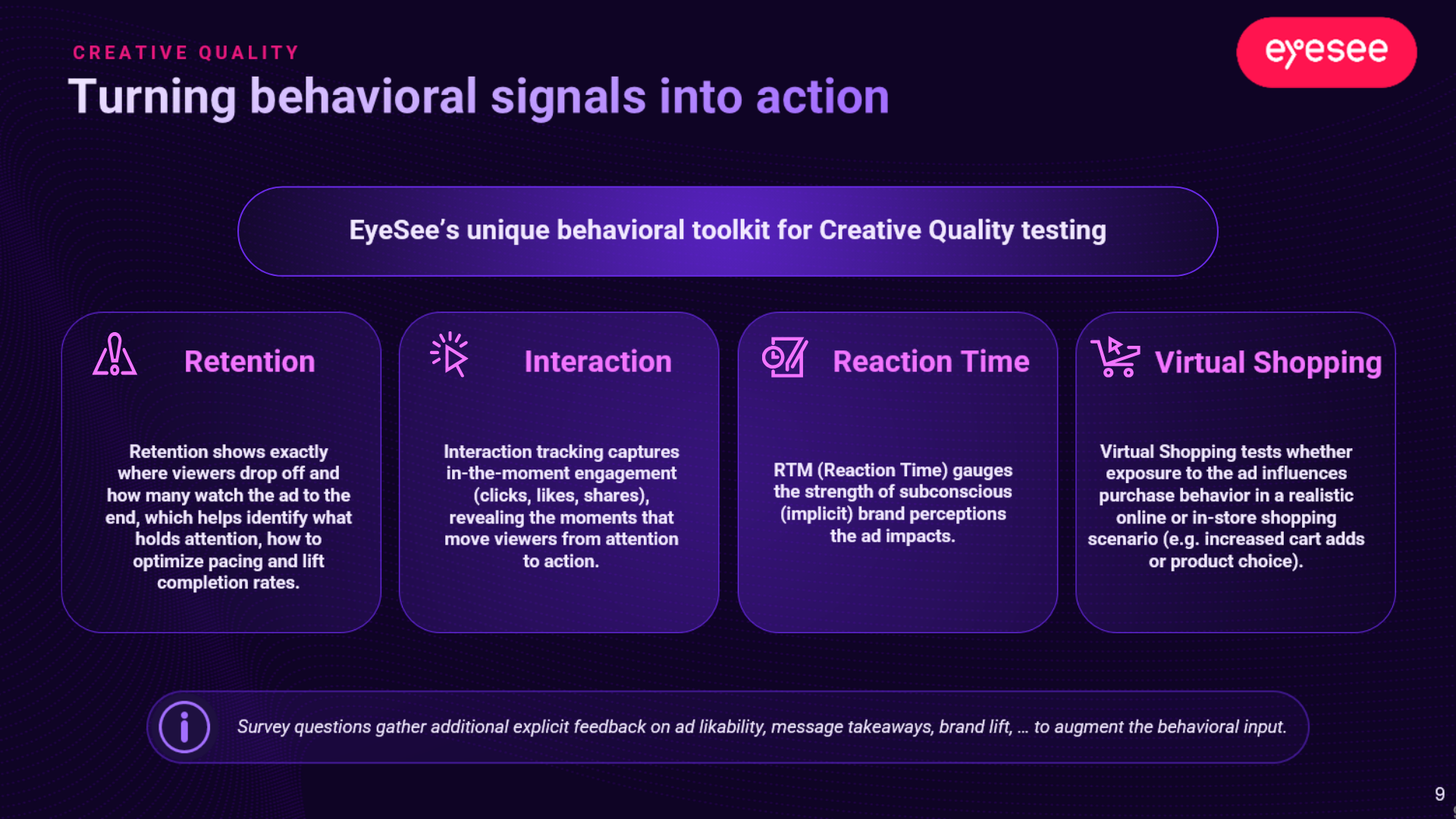
The most valuable measurement sits precisely in that gap. Not whether the ad was seen, but whether being seen changed a choice made minutes later, in a completely different environment.
Retail media now offers closed-loop sales data once a campaign is live. Pre-testing, where changes are cheapest, still mostly stops at “would you buy?”
From ad break to aisle
Closing the gap means following the same person from ad exposure into a realistic shopping environment, and observing what they actually do.
- Which product do they choose?
- What goes into the cart?
- Did exposure move behavior at all, compared with a matched group who never saw the ad?
Choice-based measures are not new. What has changed is where the choice happens. Depending on where the category is really bought, that is a full replica of an e-commerce page like Amazon or of a brick-and-mortar shelf, with the real competitive set, real prices and real clutter. These environments are validated, not assumed. In EyeSee’s validation studies, choices made in virtual shopping have correlated with real shopping behavior at 0.8 to 0.9. What people say they would buy tracks real purchases far less closely.
Purchase stops being a stated intention and becomes an observed choice.
That shift also changes the role of everything measured before it. Attention, emotion, recall and message clarity stop being the verdict and become the diagnosis: why the outcome moved, and what to change when it didn’t.
Observed outcomes change the conversations that follow
For creative teams, feedback shifts from:
“People liked Version B.”
to
“Version B moved choice, and here is the moment that drove it.”
For media teams, investment follows ads that have already shown they can change behavior, not simply ads that scored well on appeal.
For CFOs, the business case for creative begins with what people did, not what they said they might do.
The industry has spent years getting the conditions of exposure right. The next advantage belongs to brands that measure what exposure actually causes.
For shoppers, the ad break and the aisle were never separate moments. They have only ever been separate in the research.