
Aisle vs. Checkout Psychology: Mars Case Study
Shopper psychology is far from uniform across the retail environment. Walking down a main grocery aisle is a fundamentally different mental process from standing in the checkout queue. For consumer goods brands and retailers, recognizing this psychological shift is critical, not only for designing effective in-store executions, but for choosing the right virtual research methodology to test them.
In a joint webinar, Milica Kovač, Global Director of Client Services at EyeSee, and Maciek Bienias, Senior Manager of Global Customer & Shopper Insights at Mars, explored how understanding shopper mindset drives both physical store strategy and virtual testing methodologies.
Main Aisle Psychology: Planned Navigation & Category Intent
When navigating main aisles, shoppers operate with clear category intentions. They evaluate planograms, compare packaging, and decide between national brands and private labels. Because shoppers are actively focused on the category, research needs to measure visual attention, recognition speed, and purchase preference under controlled conditions.
For these category management decisions, such as testing a planogram redesign or evaluating SKU rationalization, focused 3D shelf testing isolates the shelf environment, allowing researchers to evaluate exact brand visibility and category mechanics cleanly.
When Mars evaluated an optimized main aisle assortment, the initial 3D virtual shelf study delivered a +16% category value lift. When re-tested in the EyeStore Free Navigation environment, EyeStore confirmed and reproduced the original 3D virtual shelf findings, measuring a virtually identical +17% category value lift. Across all 16 key performance indicators evaluated (covering both branded and private-label items), the two virtual testing environments produced consistent results, proving that adding spatial navigation maintains data reliability while adding full-journey context.
Checkout Psychology: Spontaneous Impulse in the Transaction Zone
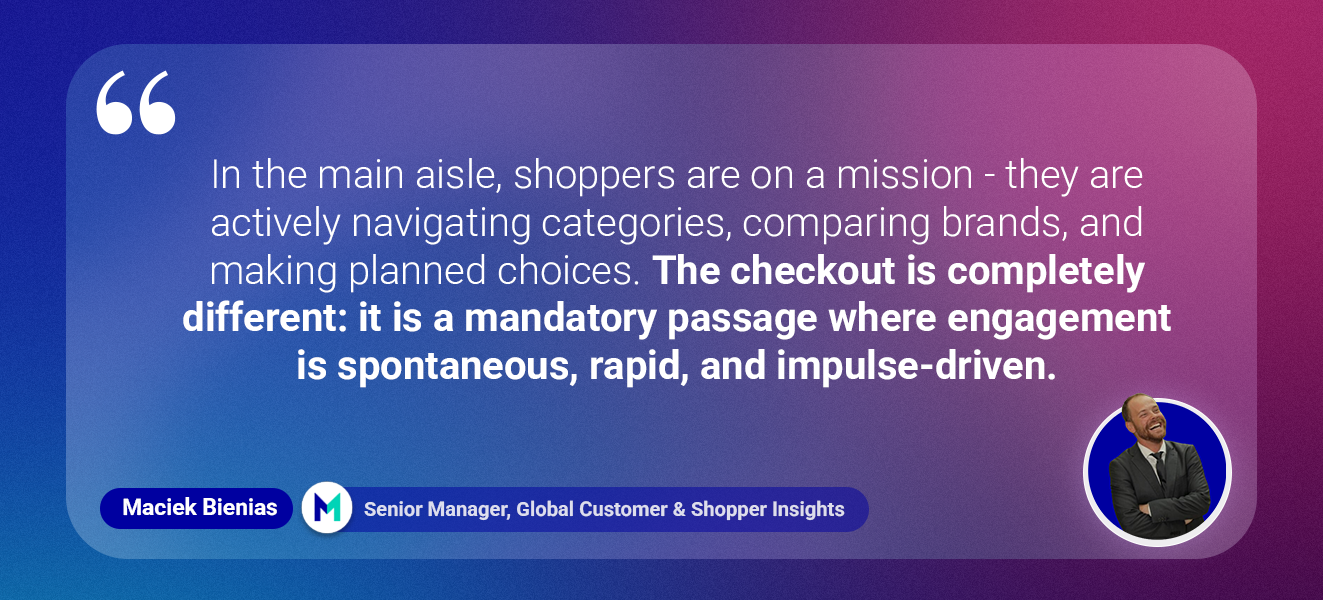
The checkout area, or transaction zone, operates on entirely different psychological principles. Shoppers do not enter the queue to shop; they enter to pay. Any product interaction here is secondary and spontaneous.
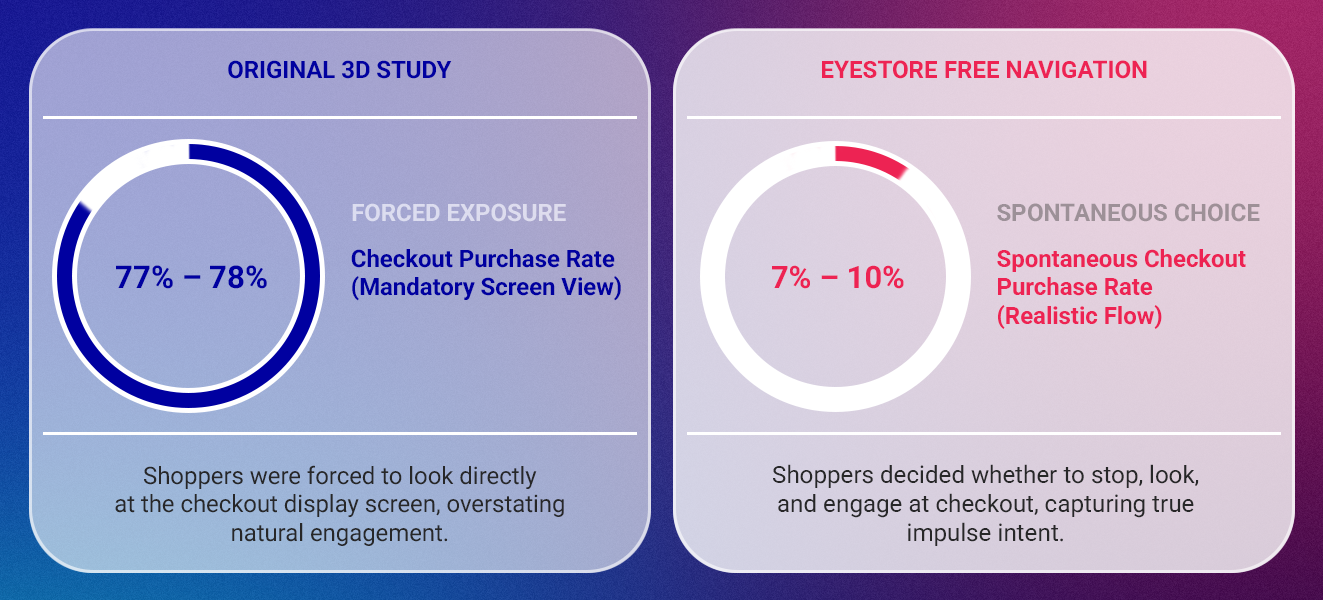
Testing impulse displays in a traditional forced-shelf setup can skew results, yielding artificial purchase intent rates as high as 77% to 78% because participants are directly prompted to examine the display.
To capture genuine impulse behavior, EyeStore Free Navigation allows participants to walk naturally through a virtual store environment, encountering the checkout organically. Under these conditions, spontaneous checkout interaction dropped to 7% to 10% - a figure that closely aligns with real-world physical store impulse benchmarks, helping Mars evaluate true impulse breakthrough during routine store transit.
Matching Methodologies to Commercial Questions
A key takeaway from the Mars and EyeSee pilot is that virtual research tools are complementary rather than mutually exclusive:
- Focused 3D Shelf Testing is ideal for planned main aisle category decisions, brand visibility, and share of shelf where shopper attention is already anchored on the category.
- EyeStore Free Navigation excels at evaluating impulse displays, secondary placements, and transaction zone engagement where spontaneous breakthrough and path-to-purchase flow are decisive.
By aligning the research methodology with the shopper's psychological mindset, brands can pre-screen concepts efficiently and de-risk physical retail rollouts before making major capital investments.
Watch the Full Webinar
Catch the complete discussion between Milica Kovač (Global Director of Client Services at EyeSee) and Maciek Bienias (Senior Manager, Global Customer & Shopper Insights at Mars) as they explore shopper psychology, methodology validation, and physical retail decision-making.